Your To-Do List Has Resigned: How to Prioritize When Everything Is Urgent
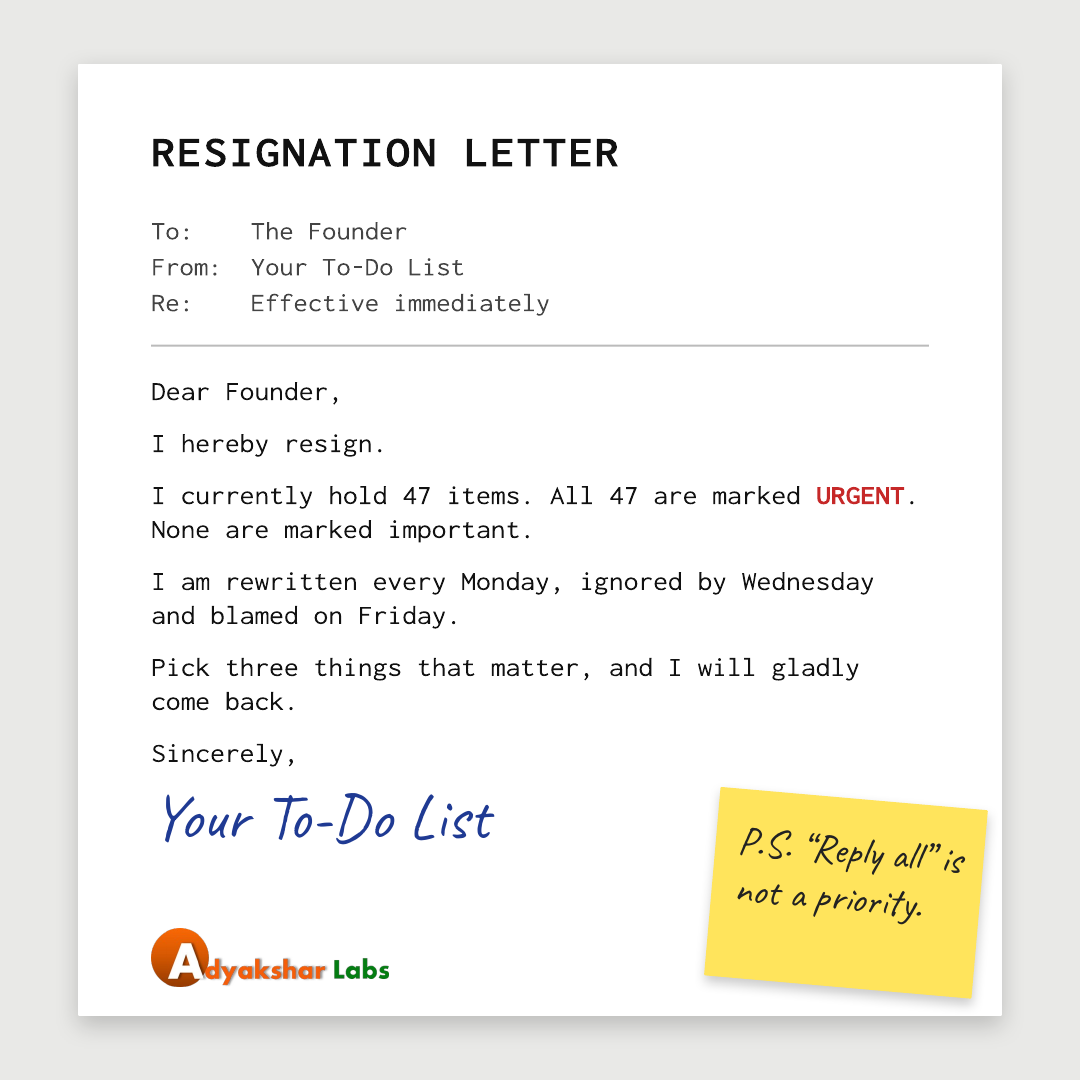
Imagine your to-do list wrote you a resignation letter.
It would probably say something like this: 47 items, all marked urgent, none marked important. Rewritten every Monday, ignored by Wednesday, blamed on Friday. Pick three things that matter, and I will gladly come back.
Most founders and managers would recognise that list. It is not a sign of laziness. It is usually a sign of a growing company, where every request feels reasonable and nobody is responsible for saying no. Here is how we think about it, both in our own work and with the teams we build for.
Urgent and important are different words
Urgent means something has a deadline. Important means something has a consequence for the business. The two overlap less often than they seem to.
A reply to an email thread is urgent. Choosing the architecture for your next product is important. A customer escalation can be both. A weekly report nobody reads is neither, yet it often survives because it is on the list and the list never forgets.
A simple test: for each item, ask what happens if it is done a week late. If the honest answer is "nothing much", it is not important, however loud it feels today.
Pick three for the week
Before the first meeting on Monday, write down three outcomes that would make the week a success. Outcomes, not tasks. "Signed agreement with the pilot customer" rather than "follow up with the pilot customer".
Three is deliberately small. It forces a choice, and it is a number you can remember without opening a tool. Everything else on the list is still allowed to happen, but it competes for the time left over, not the time first claimed.
On Friday, look at the three. If they were done, the week worked, whatever else slipped. If they were not, the reasons are usually more useful than any productivity app: an unclear owner, a dependency nobody named, or a week that filled up with meetings.
Give everything else an owner or a no
Most items on a founder's list do not need the founder. They need someone. The fastest way to shorten the list is to give each item a named owner and a date, and to accept that the owner may do it differently from how you would have.
Some items do not need anyone. These deserve a clear no, written down, so they stop coming back every Monday. A short "not this quarter" list is one of the most useful documents a small company can keep.
Separate the list from the inbox
A to-do list that anyone can add to is not a plan. It is an inbox. Keep a place where requests land, and a separate, much shorter list of what you have actually decided to do. Moving an item from one to the other should be a decision, not a reflex.
How we apply this with clients
At Adyakshar Labs we build custom technology for our clients, from AI and machine learning to web and mobile, cloud, IoT and chip design. The projects that go well tend to share the same shape: a short list of outcomes agreed up front, a named owner for each piece, and an honest no, or "not yet", for what can wait.
That is not just good project management. It is what makes timelines believable. When everything is a priority, nothing can be estimated, because the plan changes every time a new request arrives.
A five-minute exercise
Open your list today and do three things. Mark the three outcomes that matter this week. Give every remaining item an owner or move it to a "not now" list. Delete anything that has survived three Mondays without being touched.
Your list will be shorter, and it might just withdraw its resignation.
If you are planning a technology project and want a partner who works this way, visit https://adyaksharlabs.com or write to info@adyaksharlabs.com.